Flat Head Syndrome in Babies (Plagiocephaly): A Gentle McKinney Guide
Flat head syndrome, called plagiocephaly, is a flat or uneven spot that forms on a baby's soft skull from lying in the same position. It is extremely common, it is usually not painful, and in most cases it is very responsive to simple position changes, more tummy time, and gentle hands-on support — especially when you start early.
You were changing a diaper, or rinsing shampoo from that downy hair, and your hand passed over the back of your baby's head and felt it. A flat place where there used to be a curve. And something in your chest dropped.
Then came the spiral. Did I do this? Was it the car seat? Did I let them sleep too long on that side? Will their head stay like this forever? Maybe you have already started turning your phone face-down so you stop searching it at 2 a.m.
Take a breath with us. What you are feeling is not vanity and it is not overreacting. It is a mother noticing her baby closely, which is exactly what you are supposed to do. At Tula Chiropractic in McKinney, a flat spot is one of the most common things new parents quietly bring to us, often half-apologizing for worrying about it at all. You do not need to apologize. Let's walk through what it actually is.
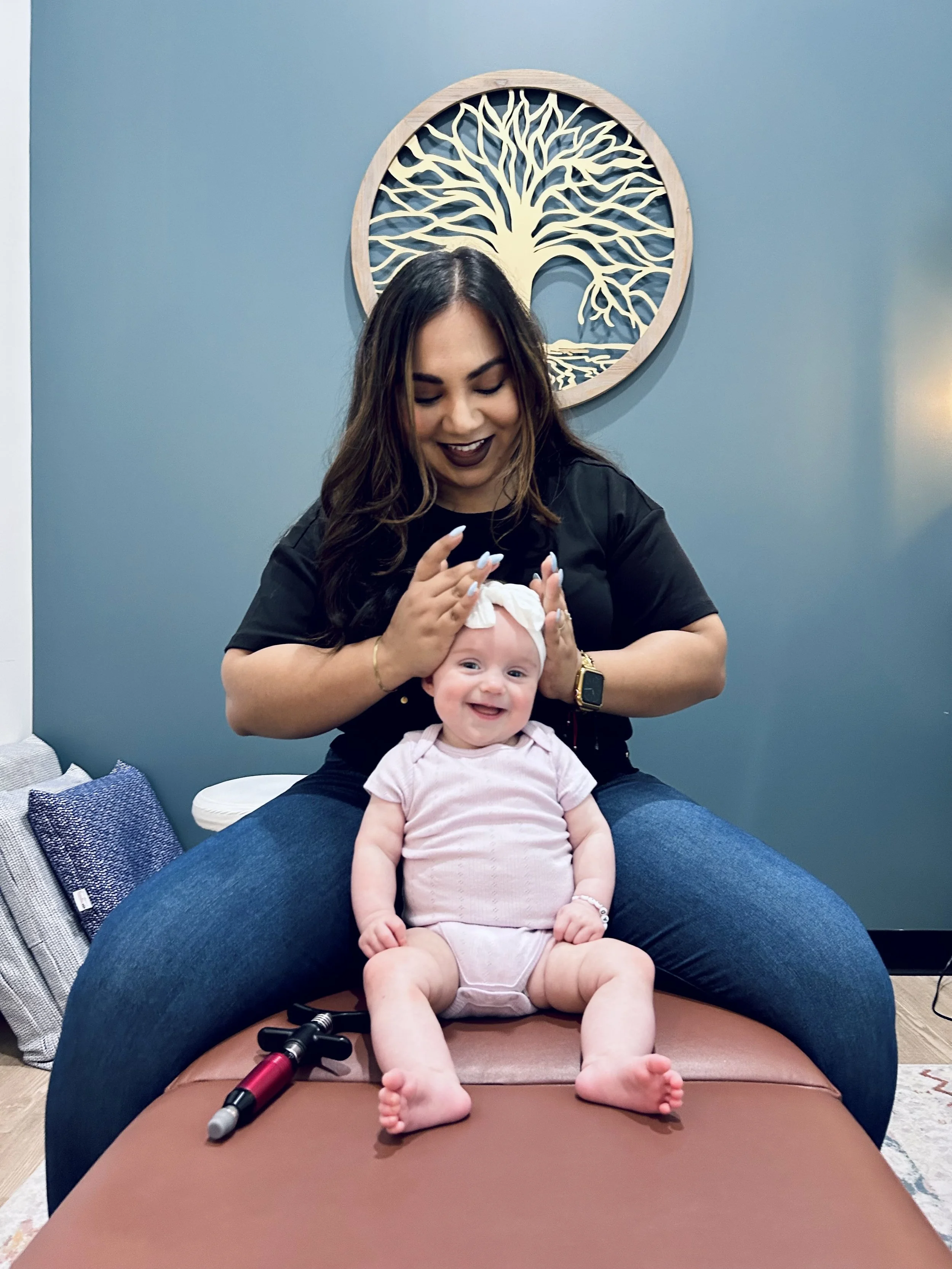
Gentle pediatric adjustment with craniosacral therapy at Tula Chiropractic
What flat head syndrome actually is
Your baby was born with a skull made of separate, soft plates that have not fused yet. That softness is on purpose. It let your baby's head mold to pass through birth, and it leaves room for a brain that grows astonishingly fast in the first year. The trade-off is that a soft skull also takes the shape of whatever it rests against most.
When a baby spends a lot of time with their head turned the same way — sleeping, in the car seat, in the swing, against your same favorite arm — gentle, steady pressure slowly flattens that one area. That is positional plagiocephaly. It is mechanical, not a sign of anything wrong inside.
Why it happens — and why it is not your fault
Here is the part most parents are never told, and the part we most want you to hear.
Flat spots became far more common after 1992, when pediatricians began recommending that all babies sleep on their backs. That single change cut the rate of SIDS dramatically — it has saved a remarkable number of babies’ lives — and at the same time, more babies developed flat spots because they spend more hours resting on the back of the head (StatPearls, NIH). Today some degree of flattening shows up in roughly one in five babies, and by some measures even more.
So if you followed the safe-sleep guidance, the guidance worked, and the flat spot is a known side effect of doing the right thing. Your baby's body is simply adapting to the world it is resting in. We can gently help it adapt differently.
The connection most parents miss: the neck
Very often a flat head is not really a head story. It is a neck story.
When a baby strongly prefers turning one direction — always gazing right, always nursing more easily on one side, tilting the head a certain way — that preference can come from tightness in the neck muscles, a condition called torticollis. The baby keeps resting on the same spot because turning the other way is harder, and the flat area deepens. Research finds that a large share of babies with torticollis also have some flattening (StatPearls, NIH).
This is why we look at the whole picture, not just the skull. If your little one always turns the same way, that pattern is worth understanding.
What actually helps (and you can start today)
The encouraging truth: most flat spots improve with simple, consistent, no-cost changes, especially in the first months while the skull is most moldable. The goal is to take pressure off the flat area and invite your baby to spend time in new positions.
More tummy time, in small doses. This is the single most helpful thing. On the tummy, the back of the head carries no pressure and both sides of the neck wake up. Start with a few minutes several times a day, always supervised and awake.
Turn the crib around. Babies orient toward the door, the window, the light. Flip which end of the crib their head goes, and they will naturally turn the less-used direction to see the room.
Switch your arms. Alternate the side you hold, feed, and carry on, so one side of the head is not always the resting side.
Less time in the “containers.” Car seats, swings, and bouncers are wonderful and necessary — just not the all-day resting place. Floor time and arms time spread the pressure out.
Follow their gaze and gently invite the other side. Place toys, your face, and sound on the side they turn away from, so turning that way becomes the fun direction.
How gentle care fits in
If the flat spot is deepening, if your baby strongly resists turning one way, or if you simply want a trained set of hands to look closely, that is exactly the moment to bring them in. We are Webster and ICPA-listed, and pediatric care is one of the seasons we hold most carefully.
A Tula visit for a little one is not a quick crack and out. It is unhurried, gentle hands-on work — soft craniosacral techniques, very gentle and careful attention to the neck and the muscles holding that turning pattern, and a look at how your baby is moving as a whole. We are not forcing a head into shape. We are easing the tension that keeps your baby stuck facing one way, so they can move freely and the pressure can finally spread out.
Most parents tell us the same thing afterward:I wish I did this sooner.
Frequently asked questions
Will my baby's head round out on its own?
Many mild flat spots do improve a lot with position changes and tummy time, especially when you start early while the skull is soft. The sooner you adjust positioning, the more the skull can respond.
Is plagiocephaly painful for my baby?
No. The flattening itself does not hurt. If there is neck tightness underneath it, your baby may show discomfort turning one direction, which is worth having looked at.
Does a flat spot affect brain development?
Positional flat head syndrome is a shape issue with the skull from outside pressure. It does not damage the brain. It is about the head's contour, not your baby's development.
When should I have it checked?
If the flat area is getting more noticeable, if your baby almost always turns the same way, or if you are simply worried, it is reasonable to have it assessed. Earlier is easier, because the skull is most responsive in the first several months.
Does my baby need a helmet?
Most babies never need one. Helmets are reserved for more significant cases that have not responded to repositioning. The large majority of flat spots are managed gently with the steps above (Cleveland Clinic).
You noticed something about your baby that most people would have missed. That instinct is the whole reason flat spots get caught early and respond so well. Trust it. We are here in McKinney whenever you want a gentle second set of eyes.
About the author: Dr. Aanchal B. Mendoza is the founder of Tula Chiropractic & Wellness in McKinney, TX. She is Webster certified and listed on the ICPA for Kids directory, with advanced training in prenatal, postpartum, and pediatric care. Tula serves families across McKinney, Prosper, Allen, Frisco, Plano, Celina, and the greater Dallas area.
